From a Graveside to a Whole Life: How a QR Memorial Plaque Works
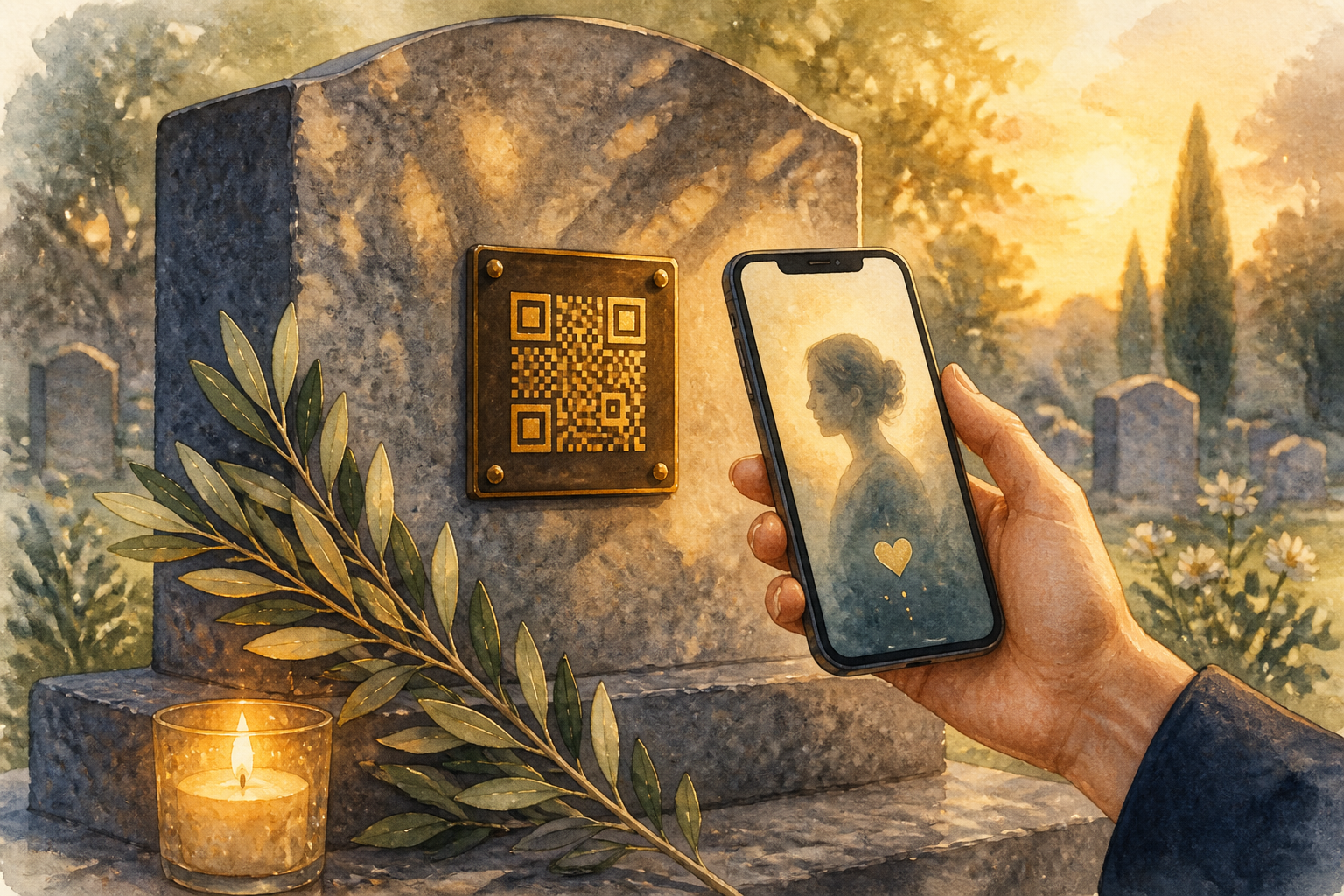
From a Graveside to a Whole Life
Stand in any cemetery and read the stones, and you'll notice how little they're able to say.
A name. Two dates, and the small dash between them that has to carry an entire life. Perhaps a line of scripture, or a few words chosen in grief and limited by the cost of every letter carved in granite. It is, for most of us, all that remains in stone — and it tells a passing visitor almost nothing about who the person actually was. The dash holds everything, and shows none of it.
A QR memorial plaque is a way to open that dash.
What it is
A QR memorial plaque is a small, scannable code you place on or beside a headstone, a memorial, or anywhere a person is remembered. A visitor points their phone at it — any phone, no app to download, nothing to install — and in a moment they're taken straight to that person's memorial wall: their face, the warm account of their life, and the gathered memories of everyone who knew them.
It turns a stone that can hold a name into a doorway that can hold a life.
Picture a grandchild, years from now, standing at a grandparent's grave they were too young to truly remember. The stone gives them a name. The code beside it gives them the person — their voice in a video, the stories an aunt wrote, the photograph from before anyone in the family was born. Or picture a stranger, pausing at a grave on a walk, who scans out of quiet curiosity and finds themselves, for a few minutes, in the company of a life well lived. The plaque doesn't replace the headstone. It completes it.
How it actually works
The code itself is generated for you. Once you've made a memorial wall, a single button opens a dialogue that creates the QR code automatically, ready to download with one click. It works on every phone, needs no app, and leads anyone who scans it directly to the wall — and, where it matters, through the wall to a whole family's history rather than a single person's.
What you do with the code is where you have real freedom — and this is a choice worth understanding, because it means you're never locked in.
You can order a finished, weatherproof plaque directly from MemWall, made to last the way a memorial should — in materials chosen to endure outdoors for decades: anodized aluminium, brass, laser-engraved stainless steel, in a range of sizes. Or you can simply download the code yourself and have it engraved or made locally, by a stonemason or a maker you trust, in whatever form suits the stone. The code is yours either way. The physical plaque is optional — some families want the durable, ready-made plate; others prefer to download the code and handle the rest themselves. Both paths lead to the same place.
The code is part of a subscription, with a free trial period so you can see how it works and try it for yourself before committing to anything. The memorial wall it points to can be created and explored freely; the scannable code is the part that carries a small ongoing cost once you choose to keep it.
More than a headstone
A grave is the obvious place for a memorial plaque, but it's far from the only one.
The same code can live in a memorial album, so that turning a page brings the person to life on a screen. It can be brought to a family gathering, passed around so that relatives — including the ones who never met the person — can meet them. And for a family memorial wall, a single code can lead not to one person but to an entire lineage: scan once at a graveside or a reunion, and you reach grandparents, great-grandparents, the whole connected family in one place. A family wall is free to build, and its code becomes active once at least one of the personal walls it gathers is on an active subscription.
When grief arrives without warning
There is one use we want to mention gently, because it matters to people in the hardest moments imaginable.
When a death is sudden — a road accident, a loss at a particular place — people gather. They bring flowers, they light candles, they leave them at the spot where it happened. It's one of the oldest and most human responses to loss. But a roadside memorial is, by its nature, fleeting and silent: the flowers fade, the candles go out, and a passer-by who pauses there knows only that someone died, never who.
A printed code, laminated and placed among the flowers and the lights, can quietly change that. In a short time, and at no cost in the first weeks, a grieving family or friend can create a memorial wall and bring a code to the place — so that the temporary becomes a way to tell the world who was lost, and so that those who stop there can know the person, and leave a memory of their own. We mention it not as a product to sell into a tragedy, but because people in those moments sometimes search for exactly this, and find nothing made with enough care. If it helps even a few families speak the name of someone taken too suddenly, it's worth saying it can be done.
The doorway and what lies beyond it
A QR plaque is the bridge between the physical world and everything a memorial holds — and it's the third part of something larger that fits together.
The memorial wall it opens onto is the gathering place: open, lasting, built by everyone who loved the person. And alongside the public remembrance, there's the private one — the memory capsule, a message held and delivered to specific people on a chosen day or when you're no longer here. Together they cover the whole shape of remembrance: the words you leave for a few, the place where many gather, and the small code that lets anyone standing at a graveside cross from a name in stone to a life fully told.
A headstone says a person was here. A plaque beside it lets anyone, for as long as the stone stands, find out who they were.